So, you want to be a teacher?
So, you want to be a teacher and now you are stressing about putting together your teaching portfolio. No problem, let’s share the stress! Haha! Lately, I have been working really hard to put together my teaching portfolio and I thought it would be a great idea to share what I have been working on. As a senior student working to start my student teaching this coming fall, I am required to submit a teaching portfolio as part of the process that I mentioned in my other post which you can easily go to by What’s My Niche. I am not sure if the requirements for putting a teaching portfolio in all universities is the same, but I will briefly go over what I need to have in my portfolio according to my university, UTPB. 
A teaching portfolio, for students who are still a little confused, is a collection of documents that demonstrate your competency in areas that prove you are prepared for teaching. In other words, it is a set of artifacts like sample lesson plans, PowerPoints, classroom designs/schemas, and other things you have created throughout your education career at the university. Think of it as a binder that has printouts of what you have learned about teaching and created for instructional purposes.
- My recommendation is to go over your created artifacts and revise and edit them so that they are in the best condition grammatically and systematically. We all know that as you are taking your courses, we don’t always get perfect scores on our assignments; which is part of our learning experience. However, when putting your teaching portfolio together, it is always best to go back and edit them before submitting them as part of your final teaching portfolio.
So, here is what is required for my teaching portfolio. My university calls it the Educator Readiness Portfolio to be exact. There are two parts of the portfolio that a student needs to focus on: submitting an artifact/document that fulfills a competency, and a typed reflection for each competency. Below are the 13 competencies I need to fulfill which are grouped into 5 categories (get ready for a long ride):
-
Credentials
- Teaching Philosophy: A teaching philosophy is generally a short essay of about one to two pages that describes your beliefs in the role of teaching and learning in society, and how those beliefs affect your classroom, school, and community. In other words, here you would write something about the teaching methods you plan to use and why, or what you believe teaching should be about and how you will use your teaching beliefs to help students, your school, and your community. Need help getting started? Here is a very rough draft preview of mine: Teaching Philosophy Purpose.
- Certification Plan: You should already have a certification plan submitted to the education/certification department at your university. All you need to do is provide a scanned PDF copy of that in your portfolio which should be stamped by the department (your education advisor can help you with this).
-
Designing Instruction and Assessment
- Competency 1 (Planning Developmentally Appropriate Lessons): For this competency, you want to submit something that demonstrates that you know how to design a basic lesson plan with activities, evaluations, and your core curriculum standards (referred to as TEKS here in Texas). Thus, you can use any subject area lesson plan that you have created.
- Type a reflection for the lesson plan that you submit.
- Competency 2a (Addressing the needs of students with learning disabilities): In this area, you can use a lesson plan, a mini-lesson, a thematic unit, or anything that demonstrates that you can understand how to develop lessons that use appropriate activities and assessment strategies that target students with learning disabilities. Ideally, you would be using a lesson plan that includes modifications and/or accommodations for students with learning disabilities. Yet, you could also use a PowerPoint Presentation that explains a learning disability and also includes teaching strategies that would be beneficial for any student with that learning disability. Make sure you know the difference between modifications and accommodations, though.
- Type a reflection for the artifact you submit.
- Competency 2b (Addressing the needs of English Language Learners): Just like the latter competency, you must provide a document that proves that you can design lessons for your class that has ELLs, or English Language Learners. In lesson plans, you can meet ELL needs by incorporating them in your modifications or accommodations section which also covers the core curriculum guidelines for ELLs.
- Type a reflection for the artifact that you used.
- Competency 3 (Planning Instruction to align with the TEKS): Now this is obviously specific to Texas because as I mentioned before, the TEKS are Texas’s core curriculum standards that teachers have to meet in their instruction. I plan to use a lesson plan that is based on at least one TEKS.
- Type a reflection for the artifact that you use.
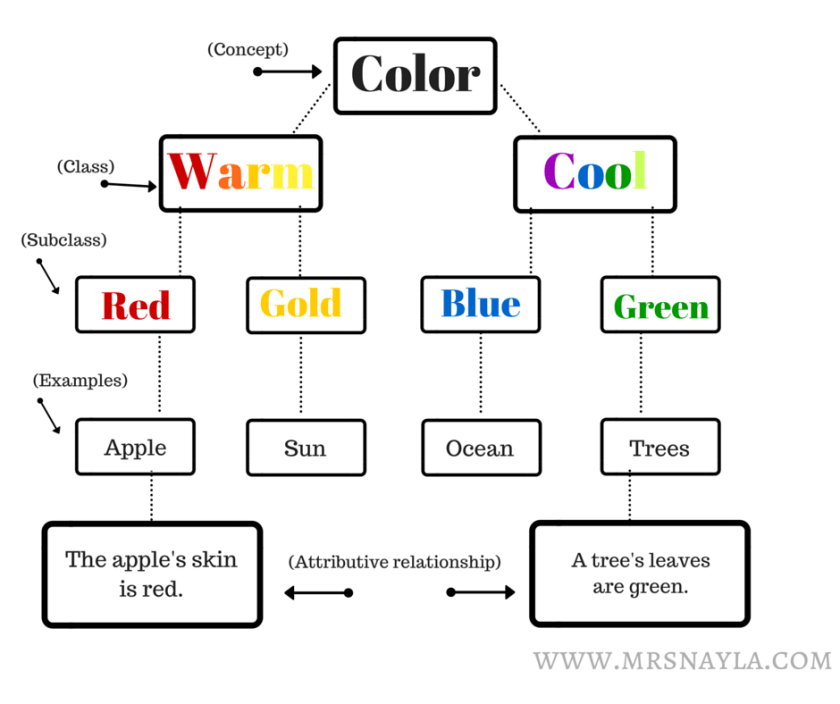
- Competency 4 (Planning based on knowledge of how learning occurs): So, for this competency, they want to see that you know how to teach concepts, which are basically ideas that are hard to explain by sole definition and sometimes needs more than one lesson or instructional day to cover. I think that the best artifact to use for this competency is a grade level unit plan, but you can also use a lesson plan that uses graphic organizers that help explain concepts. Here’s a very basic example of what I created, but you can get as creative as you want. You can find numerous examples and graphic organizer templates all over the web such as Kathy Schrock’s Concept Mapping and Citrus County School’s Graphic Organizers.
- Type a reflection for this artifact.
- Competency 1 (Planning Developmentally Appropriate Lessons): For this competency, you want to submit something that demonstrates that you know how to design a basic lesson plan with activities, evaluations, and your core curriculum standards (referred to as TEKS here in Texas). Thus, you can use any subject area lesson plan that you have created.
-
Creating a Positive Classroom Environment
- Competency 5 (Creating a supportive environment): For this section you can use any document that demonstrates that you know how to use space and materials to create a positive and supportive environment for the student. A classroom schema that you have designed in one of your education courses will work. Here is what I designed:Classroom Schema Example and Description
- Type a reflection for this artifact.
- Competency 6 (Managing student behavior): Well, if there is one thing I have learned about managing a classroom, it is that it’s not the same as disciplining your students. Here you want to submit something that indicates that you know how to create appropriate expectations for student behavior and that you have a plan for responding when those expectations are not met. An example of what can be used here is a behavior plan, student expectations and behavior intervention plan, or a poster that has your classroom policies/rules (normally up to 5) that would be put up in your classroom.
- Type a reflection for this artifact.
- Competency 5 (Creating a supportive environment): For this section you can use any document that demonstrates that you know how to use space and materials to create a positive and supportive environment for the student. A classroom schema that you have designed in one of your education courses will work. Here is what I designed:Classroom Schema Example and Description
-
Implementing Instruction and Assessment
- Competency 7 (Communicating Effectively): A teacher should be able to communicate effectively with parents, students, and other teachers in a professional manner. Thus, for this competency you want to use something that shows that you can do this. Some examples of what to use are: an introductory letter to parents, a classroom newsletter, or a lesson presentation.
- Type a reflection for this artifact.
- Competency 8 (Actively engaging students in learning): You know, your students can become bored of the same routine of you standing up infront of the class and lecturing their ears off. Therefore, you will need to know to change things up a bit and keep them engaged in learning. You can create lesson plans that are interactive. Some examples are: a reading or writing workshop lesson or a classroom activity.
- Type a reflection for this artifact.
- Competency 9 (Ability to use technology): I hope you are tech savvy because in this century, technology is a biggie. I’m not saying that you have to be a computer geek, but you should at least be able to demonstrate that you know how to embed meaningful technology in your lessons to help with material comprehension and enhance their learning. Some examples include: math technology project, internet literacy project, a PowerPoint presentation, or technology driven lesson plan.
- Type a reflection for this artifact.
- Competency 10 (Providing feedback and assessment): One of the ways that students learn and improve academically is by receiving meaningful and constructive feedback from their teachers. You will have to submit something that indicates that you understand the role of assessment and feedback in the instructional process. Some examples would be a rubric for a presentation, unit plan, or project, or an assessment activity.
- Type a reflection for this artifact.
- Competency 7 (Communicating Effectively): A teacher should be able to communicate effectively with parents, students, and other teachers in a professional manner. Thus, for this competency you want to use something that shows that you can do this. Some examples of what to use are: an introductory letter to parents, a classroom newsletter, or a lesson presentation.
-
Professional Roles and Responsibilities
- Competency 11 (Interacting with students’ families): This competency could be misleading since you don’t necessarily have to go on a picnic with a student’s family in order to interact with them. Instead, what they are looking for is your ability to invite parents and other family members to participate in their child’s learning. Some examples that you could use for this section are: a take-home parent brochure on policies (sometimes given during open house), or a family-engaging activity lesson.
- Type a reflection for this artifact.
- Competency 12 (Professional knowledge and Interactions): This is not the same as communicating with parents, students, and peers in a professional manner, but it is similar. For this section, they are looking for your ability to learn from others and interact in a professional manner. An example of what to submit for this section would be a field observation packet or a teacher interview.
- Type a reflection for this artifact.
- Competency 13 (Knowledge of legal and ethical requirements): So many teachers in the field have gotten in trouble with the law for violating student-teacher rules. This is something that should not be taken lightly because your career is on the line and you could lose it forever if you mess up. Thus, knowing your code of ethics is extremely important and to always keep them in mind when teaching is wise. Some examples of what you can submit here are: a copy of the code of ethics for teachers (TEA), or a professional handbook.
- Type a reflection for this artifact.
- Competency 11 (Interacting with students’ families): This competency could be misleading since you don’t necessarily have to go on a picnic with a student’s family in order to interact with them. Instead, what they are looking for is your ability to invite parents and other family members to participate in their child’s learning. Some examples that you could use for this section are: a take-home parent brochure on policies (sometimes given during open house), or a family-engaging activity lesson.
TIPS:
- Always save your assignments in your computer for future use, or back them up somewhere safe in case your something happens to your computer. Otherwise, you will have to do your teaching portfolio from scratch.
- Don’t try to complete your portfolio in one week. Give yourself at least a month or more to make sure that you actually do have everything that you need to turn in. Who knows, maybe you will end up not being able to find a specific file in your computer that you could use for one of your competencies.
- Do go back to revise and edit your artifact before submitting. A teaching portfolio should indicate that you are professional now; so, whatever you turn in should be your best work.
- Don’t think you are alone! There are other students in your university that are in the same position as you are now. Ask them what they are doing and how they are doing it. Sometimes, asking your peers is a way to share the stress (if you don’t know that by now).
- Get professional advice! It’s one thing to try to complete assignments with your peers and share the stress, but keep in mind that you can also go to one of your education professors that have already gone down this path. They should be able to tell you what you could tweak from your assignments and whether or not the artifact/document you plan to submit for a specific competency is acceptable.
Much love always,
 Mrs. Nayla